
Pneumatic fenders, also known as inflatable fenders or air fenders, are critical marine safety devices designed to absorb kinetic energy and reduce impact forces during vessel-to-vessel (ship-to-ship transfer operations) or vessel-to-structure (berthing at docks, piers, or offshore platforms) interactions. Their operation relies on a simple yet effective principle of compressed air cushioning. Here’s a detailed breakdown of how they work:
1. Basic Structure
Pneumatic fenders consist of three main components:
• Outer Skin: A tough, flexible layer typically made of reinforced synthetic rubber (e.g., neoprene, natural rubber, or polyurethane) with high tensile strength, abrasion resistance, and weatherability. It is often reinforced with multiple layers of fabric (e.g., nylon, polyester) to withstand high pressure and mechanical stress.
• Inner Air Chamber: A sealed cavity filled with compressed air (or nitrogen, in some cases) at a controlled pressure. This air acts as the primary cushioning medium.
• Fittings: Valves for inflation/deflation, end flanges or shackles for mounting, and sometimes protective chafing strips or chains to prevent damage during use. Qingdao Evergreen use chain nets to protect the fender body and extend the service life of Pneumatic fenders.
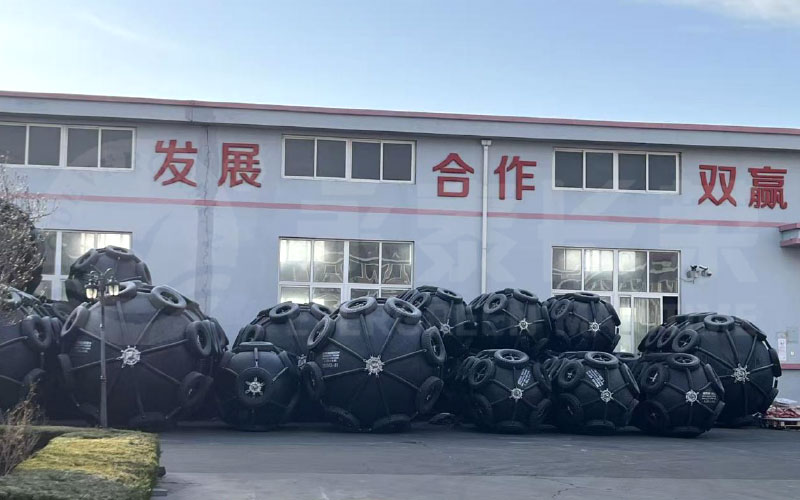
2. Core Working Principle: Compressed Air Energy Absorption
When a vessel approaches a dock or another ship, pneumatic fenders are positioned between the two surfaces. As contact occurs, the fenderdeforms under the impact load, compressing the air inside the inner chamber. This compression converts the vessel’s kinetic energy intopotential energy stored in the compressed air, effectively slowing the vessel and dissipating the impact force.
Key mechanics:
• Air Compression: As the fender is squeezed, the volume of the inner air chamber decreases, increasing the internal air pressure. This pressure rise creates arestorative forcethat resists further deformation, acting as a “spring” to cushion the impact.
• Energy Dissipation: The deformation of the fender and compression of air absorb the kinetic energy of the moving vessel. Unlike rigid materials (e.g., rubber tires or foam fenders), the air-filled chamber allows forgradual, controlled deceleration, minimizing peak impact forces on both the vessel and the structure.
• Pressure Regulation: The initial inflation pressure (typically 0.05–0.3 MPa, depending on the fender size and application) is critical. Lower pressure allows greater deformation and energy absorption, while higher pressure provides stiffer resistance for heavier vessels.
3. Deformation and Reaction Force Characteristics
Pneumatic fenders exhibit anon-linear force-deformation curve:
• Initial Contact: When the vessel first touches the fender, the rubber skin deforms easily, and air pressure rises slowly. This ensures low initial reaction force, preventing sudden jolts.
• Maximum Compression: As deformation increases (up to ~50–70% of the fender’s diameter), air pressure rises sharply, generating higher reaction forces to halt the vessel’s motion.
• Recovery: Once the impact load is removed, the compressed air pushes the fender back to its original shape, ready for reuse.
4. Advantages of Air Cushioning
• High Energy Absorption: Pneumatic fenders can absorb large amounts of energy per unit weight compared to solid fenders (e.g., foam-filled or rubber fenders), making them ideal for large vessels (e.g., oil tankers, container ships) with high berthing energy.
• Adjustable Stiffness: By varying the inflation pressure, operators can tailor the fender’s performance to different vessel sizes, speeds, and environmental conditions (e.g., rough seas).
• Floating Capability: Most pneumatic fenders are buoyant, allowing them to self-position with changing tide levels or vessel freeboard, ensuring consistent protection during berthing.
• Shock Absorption: The air chamber minimizes vibration and impact shocks, reducing stress on ship hulls, dock structures, and cargo (e.g., during liquid cargo transfers).
5. Applications
Pneumatic fenders are widely used in:
• Ship-to-Ship (STS) Operations: Transferring oil, liquefied natural gas (LNG), or bulk cargo between vessels at anchor or in open sea.
• Large Vessel Berthing: Berthing of tankers, container ships, and cruise liners at ports or offshore terminals, where high energy absorption is critical.
• Offshore Structures: Protecting oil rigs, wind farms, and floating production storage and offloading (FPSO) units during crew transfers or supply vessel operations.
6. Safety and Maintenance
• Pressure Monitoring: Regular checks ensure the internal pressure remains within the recommended range. Over-inflation can reduce deformation capacity and increase reaction forces, while under-inflation may cause the fender to collapse or fail to absorb energy effectively.
• Inspection: The outer skin is inspected for cuts, abrasions, or leaks, and valves/fittings are checked for airtightness.
Summary
Pneumatic fenders work by using compressed air trapped in a flexible, reinforced rubber chamber to cushion impacts. When compressed during vessel contact, the air absorbs kinetic energy, deforms gradually, and dissipates forces, protecting both the vessel and the structure. Their adaptability, high energy absorption, and ease of pressure adjustment make them indispensable in marine operations requiring safe, controlled berthing or transfer.