
Foam-filled fenders (solid polyurethane fenders) offer significant advantages in applications for offshore floating docks, primarily reflected in the following aspects:
• Core protective functionality: Utilizing lightweight, highly elastic closed-cell foam as the shock-absorbing medium and coated with a polyurethane elastomer for enhanced corrosion resistance, these fenders achieve high energy absorption efficiency with a reasonable reaction force variation when compressed by 60%. They effectively mitigate impact forces during vessel berthing, reducing damage to both hulls and dock structures.
• Adaptive floating performance: Equipped with self-floating capabilities, they automatically adjust their position with tidal fluctuations, enabling installation without tidal range restrictions. This makes them particularly suitable for offshore floating docks and other scenarios with frequent water level changes, ensuring continuous protection across varying tidal conditions.
• Durability and low maintenance: Constructed from acid/alkali-resistant, impermeable, and aging-resistant materials, they boast a service life of 10–15 years. Requiring no inflation maintenance, they are secured via chain suspension or flange connections, offering simple installation and low operational costs.
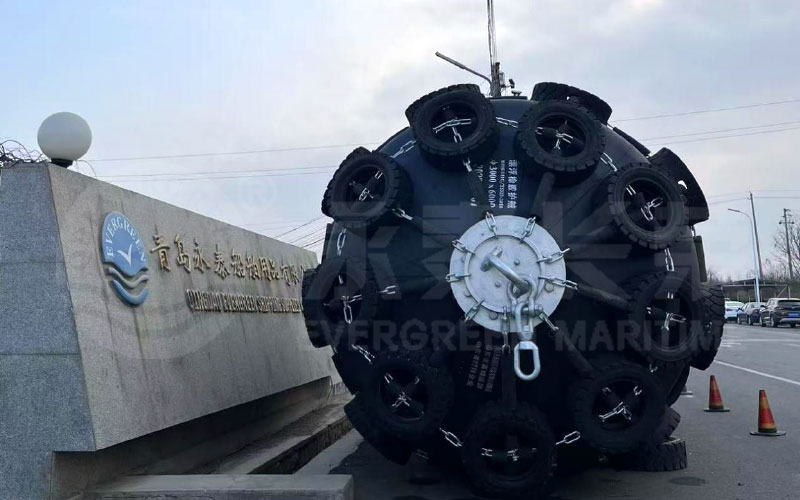
•Versatile application scenarios: Beyond floating docks, they are ideal for ship-to-ship operations, oil platforms, and other marine environments, demonstrating adaptability to harsh conditions such as seawater corrosion and UV exposure while balancing safety and cost-efficiency.
Their comprehensive performance establishes them as an optimal choice for offshore floating dock protection, harmonizing cushioning effectiveness, environmental adaptability, and long-term cost benefits.